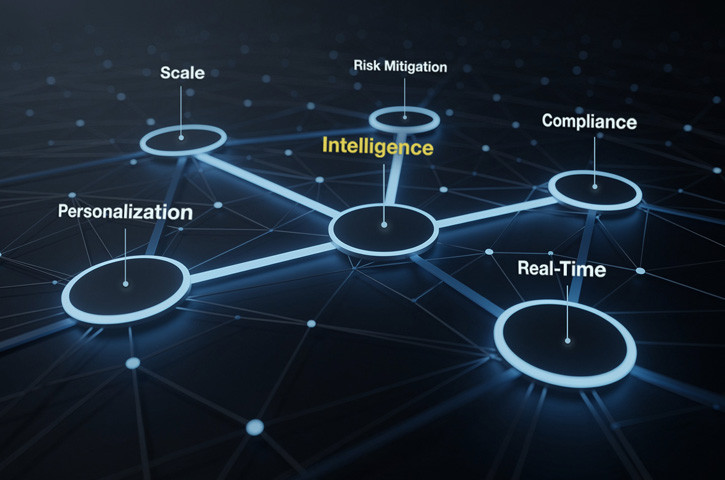
WHY GAMING & BETTING LEADERS ARE ABANDONING SILOED OPERATIONS FOR AI-DRIVEN PERSONALIZATION, COMPLIANCE, AND REAL-TIME CONTROL IN 2025
Imagine this: A betting operator loses $2.5M to compliance penalties because player data sat fragmented across seven disconnected platforms. Meanwhile, a competitor running the same license uses unified AI to predict player risk in real-time, reduce churn by 18%, and still pass audit in half the time. By 2025, this isn't a hypothetical—it's the cost of inaction.
The global gaming and betting market is projected to reach $185 billion by 2033, growing at 7.7% annually. Yet enterprise leaders face an uncomfortable truth: without integrated AI-driven personalization and compliance automation, you're leaving margin on the table and exposure on the regulatory side. The market is moving fast. In 2024, the AI in gaming segment alone was valued at $1.5 billion and is forecast to grow at a staggering 20.8% CAGR—a signal that operators treating AI as optional are already falling behind. This article examines why industry leaders in betting, retail, fintech, and gaming are abandoning legacy tech stacks for AI-powered decision engines that drive player lifetime value, shrink operational risk, and automate compliance monitoring.
AI Personalization Is Now the Primary Driver of Player Lifetime Value
Hyper-personalization powered by AI is no longer a differentiator—it's table stakes. Advanced algorithms analyze player behavior, preferences, and engagement patterns to tailor gameplay, in-game content, and betting recommendations in real-time. The result? Operators report measurable uplift in engagement, retention, and average revenue per user.
According to a LinkedIn market research, personalized gaming experiences can elevate revenue per user by up to 30%. In practice, operators using AI-driven behavioral segmentation—not just demographic—are building micro-audiences that respond to tailored offers.
Why it matters: Player lifetime value is the true north for gaming executives. When you can predict what a player wants before they do, you reduce churn, increase cross-sell, and build emotional loyalty. For a mid-market operator with 500K active players, a 5% LTV improvement translates to tens of millions in incremental revenue—all from better data science, not bigger ad spend.
Regulatory Compliance Is Becoming a Competitive Moat, Not Just a Cost Center
Regulation is no longer a friction point—it's becoming a strategic advantage for operators who get ahead of it. Across Latin America, Africa, and Asia, new markets are shifting from offshore tolerant environments to strict licensing models. Brazil, Kenya, and the Philippines have all tightened KYC, AML, and advertising rules in 2024–2025. Meanwhile, in mature markets, enforcement is already severe: EU fines under GDPR have accumulated to €5.65 billion across 2,245 cases—a stark reminder that compliance gaps scale with penalty severity.
Leading operators are deploying AI for compliance as a core operational layer, not an afterthought:
- Biometric KYC: Verification now happens in 30–60 seconds using AI-powered facial recognition, liveness detection, and anti-deepfake algorithms. This cuts friction (fewer abandoned signups) while improving accuracy and audit readiness.
- Real-Time AML Monitoring: AI systems analyze transactions, behavioral anomalies, and network patterns to flag suspicious activity before settlement, reducing operator exposure and remediation costs.
- Responsible Gambling Advancements: AI-driven responsible gambling tools use machine learning to identify at-risk players in real-time. Behavioral analysis alerts operators to players who chase losses, consistently run overnight sessions, show signs of increasing bet sizes under stress and more. Operators can now act to prevent harm before it occurs.
- Affiliate Compliance Monitoring: AI audits where ads appear, how affiliates present the brand, and whether promotions meet regulatory standards across thousands of touchpoints. This catches violations before regulators do.
Compliance is expensive. But non-compliance is catastrophic. An operator in a regulated market facing a $10M fine is competing against one that invested $500K in AI-driven compliance automation and avoided the penalty entirely. Smart leaders view compliance tech as risk insurance and brand defense rolled into one.
AI-Driven Problem Gambling Prevention Is Reshaping Player Care and Retention
Responsible gambling has evolved from optional feature to regulatory expectation and brand differentiator. Spain's gambling regulator built an AI-driven system that monitors 60+ behavioral and transactional variables in real-time to identify at-risk players. Ontario and Greece now expect similar systems as table stakes for licensing.
AI enables early intervention at scale:
- Real-time Detection: Machine learning identifies warning signals—loss-chasing, late-night escalation, betting pattern shifts—before harm occurs.
- Personalized Intervention: AI determines the right message, at the right time: a cooling-off suggestion, a betting limit, or a redirect to support.
- Outcome Measurement: Operators using AI-powered responsible gambling tools can now prove impact (reduced churn, fewer self-exclusions, lower complaint rates) to regulators and stakeholders.
In 2025, the European Gaming and Betting Association reported that 21 million customers used safer-gambling tools, and 67 million safety messages were sent to players—a proof point that scale and personalization are both possible with AI.
Player welfare and operator profitability are not in conflict when AI is the bridge. Responsible gambling tools actually increase lifetime value by extending playing careers and reducing churn from burnout. Leading operators now report that players using responsible gambling tools stay longer and spend more predictably.
Speed-to-Market Automation Is Compressing Campaign Lifecycle from Weeks to Days
In retail, travel, fintech, and especially gaming, where odds, player preferences, and market conditions shift hourly—speed wins. AI automation is collapsing the time between insight and action.
With AI-powered marketing automation and real-time personalization:
- Audience Segmentation: What once took 3–4 days now happens in hours. Behavioral ML identifies micro-segments in real-time.
- Creative Optimization: According to our own research at Streameye, generative AI drafts, tests, and refines campaign variants in minutes, cutting production cycles by 70%.
- Odds & Content Adjustment: Dynamic pricing and game mechanics respond to player feedback and market signals without manual intervention.
In fast-moving markets, speed is a moat. Operators that can launch personalized betting offers, live game shows, and new mechanics faster than competitors capture novelty value and media attention. For daily or multi-times-per-week content cycles (the reality for market leaders), compression of operating cycles directly translates to revenue and retention gains.
Cloud-Native Infrastructure + AR/VR + Real-Time Decisioning Is Redefining Player Experience as Competitive Moat
The convergence of immersive tech (AR/VR), AI-driven personalization, and real-time cloud infrastructure is reshaping how games are developed, delivered, and monetized. Live game shows (like Evolution Gaming's Crazy Time), which is a blend between TV entertainment and interactive betting, powered by cloud streaming and AI-driven host interaction.
According to SOFTSWISS's 2026 iGaming Trends Report, AI goes operational, with 56% of iGaming companies listing AI integration as a top-three business priority. Real-time infrastructure allows personalized game mechanics, dynamic difficulty, and adaptive betting limits—all tailored to individual player profiles without latency.
Why it matters: Player experience is increasingly inseparable from tech. Operators that can deliver seamless, low-latency, AR/VR-enabled, AI-personalized experiences win mind share. Younger players (Gen Z betting and gaming cohorts) expect personalization and immersion as baseline. Legacy platforms offering static game menus and generic odds will struggle to compete.
The Convergence: Why C-Level Leaders Must Act Now
The 2025 trends above paint a clear picture: gaming and betting leaders are consolidating around a new operational model: AI-enabled, real-time, player-centric, compliance-native ecosystems.
Operators still running siloed CRMs, manual compliance workflows, and static player acquisition funnels face a compounding cost penalty:
- Margin Squeeze: Competitors using dynamic odds, personalization, and waste reduction run 12–18% leaner operations.
- Regulatory Exposure: Non-integrated compliance systems leak risk. One missed AML flag can cost millions in fines and suspension.
- Talent Drain: Top operators are hiring data engineers and AI specialists; legacy platforms lose them to burnout and frustration.
- Market Share Loss: Younger, nimbler entrants using cloud-native stacks and AI launch faster, iterate quicker, and capture novelty premiums.
The business case is clear: Invest in integrated AI-driven operations now, or cede margin and market share to those who have.
Closing
By 2026, the question won't be "Should we use AI?" It will be "How much operational leverage did we leave on the table by waiting?" The gaming, betting, fintech, and retail industries are converging on a shared playbook: unify first-party player data, deploy AI for real-time personalization and risk management, automate compliance, and measure everything. Leaders that execute this blueprint early—with transparent AI, ethical player care, and rigorous measurement—will own the next decade of growth. Those that don't will compete on legacy cost-per-acquisition metrics and hope regulation doesn't shift. The margin and mind share go to the fast, the thoughtful, and the data-driven. If you're ready to future-proof your operation, StreamEye's portfolio of dynamic creative and real-time personalization solutions can help you compress time-to-market and prove ROI across your entire player lifecycle.
LATEST IN THE BLOG

NEMOCLAW: NVIDIA'S ANSWER TO THE AGENT SECURITY CRISIS

MAXIMIZING SALES: HOW DYNAMIC ADS ELEVATE YOUR E-COMMERCE MARKETING FUNNEL

FROM BRANDED TEMPLATES TO VIRAL HITS: HOW STREAMEYE CAN HELP YOU CREATE TIKTOK ADS THAT RESONATE

WHY GAMING & BETTING LEADERS ARE ABANDONING SILOED OPERATIONS FOR AI-DRIVEN PERSONALIZATION, COMPLIANCE, AND REAL-TIME CONTROL IN 2025